Web3 Payroll Streaming & Micro-Benefits: The Future of Global Remote Workforce Settlement
TL;DR (Quick Summary)
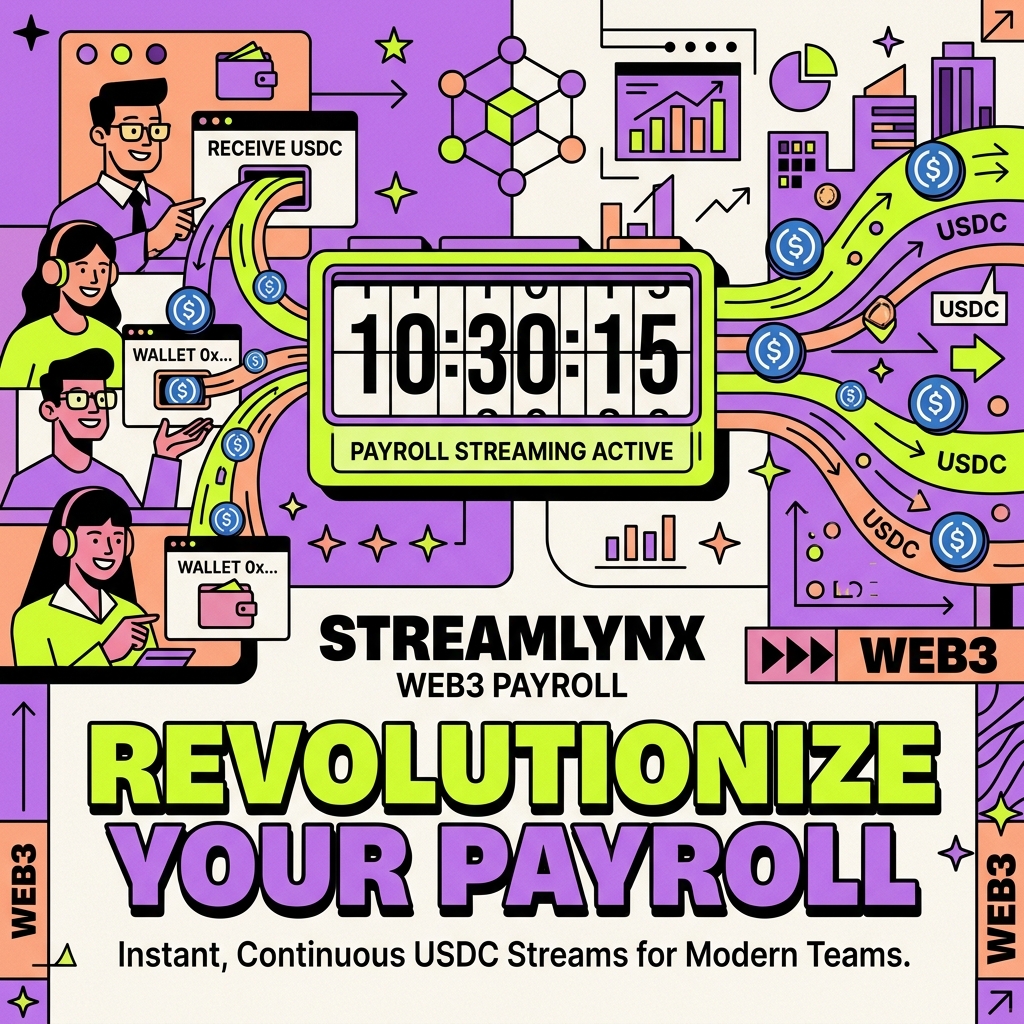
- Continuous Wages: Rather than batch payment intervals, Web3 Streaming enables per-second payroll accrued dynamically on-chain.
- Circle User-Controlled Wallets (UCW): Secure PIN & biometric web enclave authentication provides users with non-custodial custody of their funds.
- Gasless Design: Using Arc Chain (USDC as native gas) and smart contracts sponsorship (paymasters) completely deletes gas friction for the worker.
- Co-op Risk-Pooling: Diverting 20% of HSA benefits splits into a global Community Co-op Pool funds safety nets for medical claim deficits.
1. Understanding Continuous Payroll (Salary Streaming)
Modern employment paradigms are increasingly decentralized and remote, yet employee compensation rails remain anchored to outdated 20th-century banking architectures. Standard 30-day payroll cycles create capital lockups, expose workers to international wire costs, and exclude gig contractors from institutional benefits.
Salary streaming models payroll as a continuous mathematical function of elapsed time. Rather than releasing funds in discrete bi-weekly chunks, capital flows dynamically in real-time.
Real-World Impact
Consider a worker earning 3,600 USDC per month. Under legacy models, they work 30 days before receiving a single cent. Under NexaFlow, they earn 0.001388 USDC every second. They can withdraw 120 USDC after just one day of labor to cover urgent bills or deposit into high-yield vaults, giving them ultimate sovereign control over their money.
2. The Pain Points of Traditional Cross-Border Payroll
Exorbitant Intermediary Fees
SWIFT networks, currency exchange spreads (1.5% - 4%), and local receiving bank costs drain value from remote workers' paychecks before they ever arrive.
Multi-Day Transaction Delays
International banking transfers frequently require 3-5 business days to clear, causing severe liquidity shortages for workers in developing economies.
Absence of Portable Benefits
Cross-border freelancers and contractors do not receive standardized health insurance plans, pension matching, or emergency safety nets from corporate employers.
3. Core Architecture: Arc Chain & Circle Web3 Wallets
NexaFlow resolves these structural inefficiencies by combining a native stablecoin blockchain with premium custodial APIs:
Arc Chain: USDC as Gas Token
Unlike other blockchain L2 networks that require users to buy and maintain gas balances (such as ETH or MATIC), Arc Chain treats **USDC as its native gas token**. Every contract interaction consumes USDC directly, making onboarding incredibly intuitive for non-crypto native users.
Circle User-Controlled Wallets (UCW)
To prevent platform rug-pulls or central security leaks, NexaFlow implements Circle UCW. Private keys are encrypted and stored in secure cloud-enclaves (HSMs). The employee signs transactions and executes withdrawals using a secure PIN or FaceID/TouchID challenge (WebAuthn).
| Metrics | Legacy Banking | NexaFlow Web3 |
|---|---|---|
| Settlement Speed | 3 to 5 business days | Sub-second block finality |
| Execution Fees | $15 - $50 per wire + FX spreads | Sponsored (Zero fee for worker) |
| Security Model | Centralized (Bank controlled) | Non-custodial (PIN Enclave) |
4. Embedded Micro-Benefits Splitting
Instead of manually moving wages into sub-accounts, NexaFlow introduces automated routing. Upon withdrawing wages, the smart contract automatically executes allocation splits defined by the employee:
HSA Health Savings
Automated splits feed the worker's decentralized healthcare vault.
Pension Reserves
Funds hưu trí vaults and yield-bearing collateral pools.
Co-op Shared Treasury
Redirects 20% of HSA splits into a mutual safety pool.
5. Community Co-op Safety Pool Logic
NexaFlow reinvents medical protection with an on-chain risk-sharing safety net. If a member submits an invoice (V_claim) exceeding their personal HSA balance (B_member), the deficit (D) is absorbed by the Community Safety Pool (T_coop):
- Scenario A: If D ≤ 0, deduct the full invoice amount from the member's HSA: B_member = B_member - V_claim.
- Scenario B: If D > 0 and T_coop ≥ D, empty the member's HSA and deduct the deficit from the shared Co-op Pool: B_member = 0; T_coop = T_coop - D.
- Scenario C: If D > 0 and T_coop < D, the transaction reverts to secure protocol solvency.
6. Developer Common Mistakes
- Gas Decimals vs Token Decimals: Mistakenly parsing ERC-20 token transfers using 18 decimals instead of standard USDC 6 decimals, or vice versa for native gas calls.
- Exposing Enclave Keys: Hardcoding Circle SDK app credentials or developer signing keys inside React client components instead of loading via node variables.
- Viem Checksum Crashing: Sending mixed-case raw strings to Viem without applying `.toLowerCase()` validation checkups first.
7. Frequently Asked Questions (FAQ)
Q1: Do I need a browser extension like MetaMask to register?
No. NexaFlow integrates the Circle Web Enclave SDK, allowing users to register a secure smart wallet with just a password or security PIN.
Q2: Can employers claw back salary streams?
Employers can only claw back the unclaimed, un-streamed balance of an active stream. Accrued wages belong strictly to the employee.
Q3: How secure are User-Controlled Wallets?
Extremely secure. Private keys are encrypted inside HSM hardware and can only be recovered using the user's secret PIN or backup security questions.
Q4: What blockchain does NexaFlow use?
We operate natively on Arc Testnet, an EVM chain where USDC is the native gas token for predictable stablecoin transactions.
Q5: Are there any gas fees when I withdraw my salary?
No. NexaFlow integrates smart contract paymasters that sponsor all withdrawal and benefits split operations, ensuring a zero-fee experience for the worker.
Q6: What happens if the Community Co-op Safety Pool runs out of funds?
If a deficit exceeds the available liquidity in the shared treasury, claims revert on-chain to secure protocol solvency until voting replenishes the treasury.
Q7: Can I hook my own external ledger or hardware wallet?
Yes. NexaFlow supports RainbowKit, meaning you can connect any wallet like MetaMask, Rabby, or WalletConnect as an alternate method.
Q8: How does the AI Verifier Agent protect the insurance pool?
The LangGraph agent checks invoice OCR data, validates the medical provider's identity, and screens against OFAC sanctions lists before signing.
Q9: How are tax liabilities recorded on-chain?
Every withdrawal and allocation split creates a permanent cryptographic record, exportable via CSV or JSON formats for local tax reporting.
Q10: What happens if I forget my Circle UCW PIN?
You can restore access using your pre-configured security questions. If both the PIN and security answers are lost, the wallet cannot be recovered.
Conclusion
Continuous salary streaming represents the ultimate evolution of workforce payment rails. By aligning compensation with real-time labor, NexaFlow eliminates cash-flow constraints, while Circle Wallets and Arc Chain deliver institutional security with zero gas friction.